Raspberry Pi 4 Model B with 4GB RAM
The Raspberry Pi 4 Model B with 4GB RAM is a credit-card-sized single-board computer built around a Broadcom BCM2711 quad-core Cortex-A72 chip running at 1.5 GHz. The 4GB version sits in the middle of the range, and for most network and IoT projects it is the sensible choice. Street prices are usually around 55 to 65 euros for the board alone, though that moves with stock.
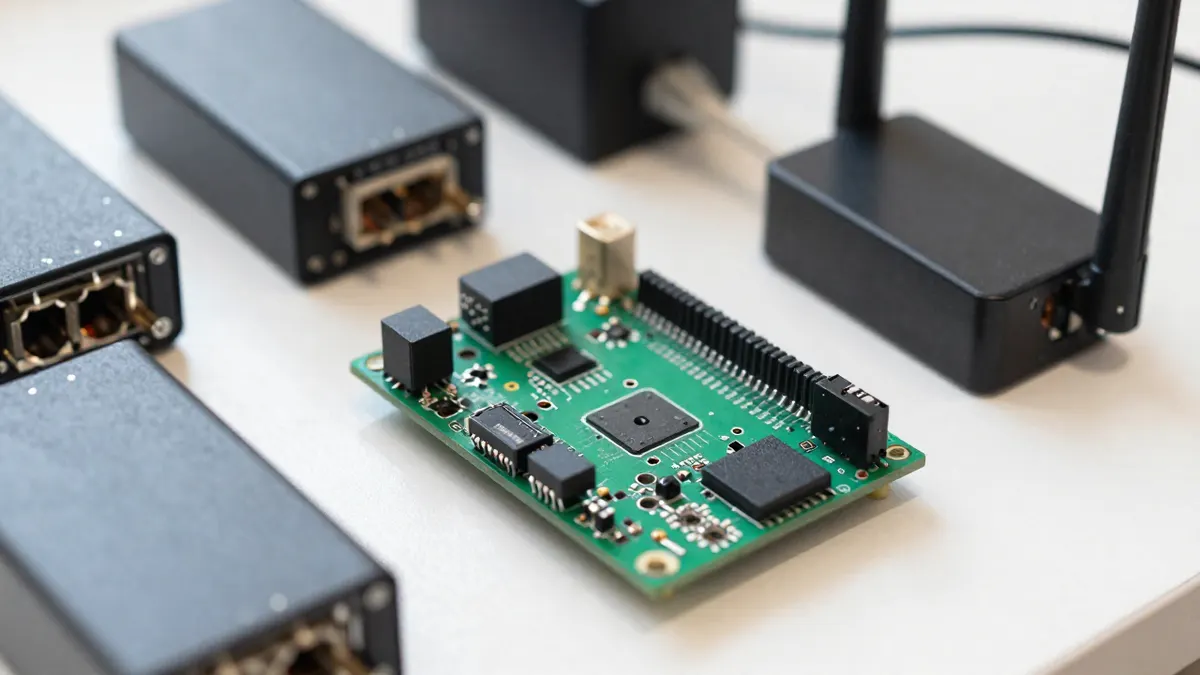
Raspberry Pi 4 Model B specifications
Here is what is on the board itself.
- CPU: 64-bit quad-core ARM Cortex-A72, 1.5 GHz
- Memory: 4GB LPDDR4-3200
- Network: Gigabit Ethernet, dual-band Wi-Fi 802.11ac, Bluetooth 5.0
- USB: two USB 3.0 ports and two USB 2.0 ports
- Video: two micro-HDMI ports, up to 4K at 60 Hz on one display
- Storage: microSD slot, plus boot from USB or network
- Power: USB-C, 5V at 3A
The Gigabit port is the real upgrade over the Pi 3, which shared its Ethernet with a USB 2.0 bus and topped out near 300 Mbit/s. On the Pi 4 you get close to full line speed.
Is 4GB enough, or do you need 2GB or 8GB?
For a Linux desktop with a few browser tabs, 4GB works fine. For a headless server, a Pi-hole, a small Docker stack or a LoRaWAN gateway, 2GB would already do the job, and 8GB is wasted. I would pick 4GB if you want room to grow without paying the 8GB premium, which is roughly 20 to 25 euros more.
Using the Raspberry Pi 4 Model B for LoRaWAN and Helium
Many early Helium hotspots were really a Pi with a concentrator board on top. A typical build pairs the Pi with an RAK2245 or similar SX1301 or SX1302 HAT, a LoRa antenna and a decent power supply. Expect a finished DIY gateway to draw about 3 to 5 W.
Be honest about the state of the network, though. Rewards for new coverage have fallen a lot, and a DIY build rarely pays back quickly. If you only want to contribute coverage or map it, a ready-made option such as a plug-and-play helium mapper is less work than assembling and flashing a Pi yourself. And if what you really need is a secure, low-power network box rather than a LoRa gateway, the Deeper Connect Mini mining edition is a different tool for a different job.
Power and cooling
The Pi 4 runs warm. Under sustained load it reaches 80 °C without a heatsink and starts throttling at that point. A small aluminium case or a passive heatsink costs a few euros and keeps temperatures in the 50 to 60 °C range.
Use an official-grade 5.1V 3A USB-C supply. Cheap cables cause undervoltage warnings, and those are behind most "random reboot" complaints.
Power over Ethernet
The board has no PoE circuit of its own, but it has a 4-pin header for the official PoE HAT, which is built for 802.3af/at networks. For outdoor installs near an antenna, a 48V PoE injector at the switch end lets you run one cable up to 100 m. Check that the HAT and the injector both match the standard you use.
Storage and operating system
A 32GB microSD card, class A1 or A2, is enough for Raspberry Pi OS. For anything that writes constantly, such as a gateway keeping logs, SD cards wear out within a year or two. A small USB 3.0 SSD is the better answer, and the Pi 4 boots from it natively on current firmware.
Raspberry Pi 4 Model B versus the Pi 5
The Pi 5 is roughly two to three times faster and adds a PCIe connector, but it needs a 5V 5A supply for full performance and costs more. The Pi 4 remains well supported, has the larger pool of tutorials and HAT compatibility, and uses less power. For a LoRa gateway the extra speed of the Pi 5 gives you nothing.
Frequently Asked Questions
Does the Raspberry Pi 4 Model B have built-in Wi-Fi?
Yes. It includes dual-band 802.11ac Wi-Fi and Bluetooth 5.0. For a gateway or server, wired Gigabit Ethernet is still the more reliable choice.
What power supply does the 4GB model need?
A 5.1V, 3A USB-C supply. The board itself idles at around 3 W, but USB devices and a HAT raise the peak draw, so a weaker charger often causes instability.
Can I run a Helium hotspot on a Raspberry Pi 4?
You can build a LoRaWAN gateway with it using a compatible concentrator HAT and antenna. Check current network rewards and local regulations before you spend money, since returns vary a lot by area.
How long does a microSD card last in a Pi 4?
With light use, several years. With constant logging, often 12 to 24 months. Moving the system to a USB SSD removes the problem.