Helium Miner Accessories: Adapters, Connectors and Add-ons
Most hotspot problems trace back to the small parts, not the miner itself. A wrong connector type, a cable that is too long or a missing surge protector can cost more coverage than a cheap antenna ever will. This guide covers the helium miner accessories that matter for a LoRaWAN hotspot, and how to pick them without guesswork.
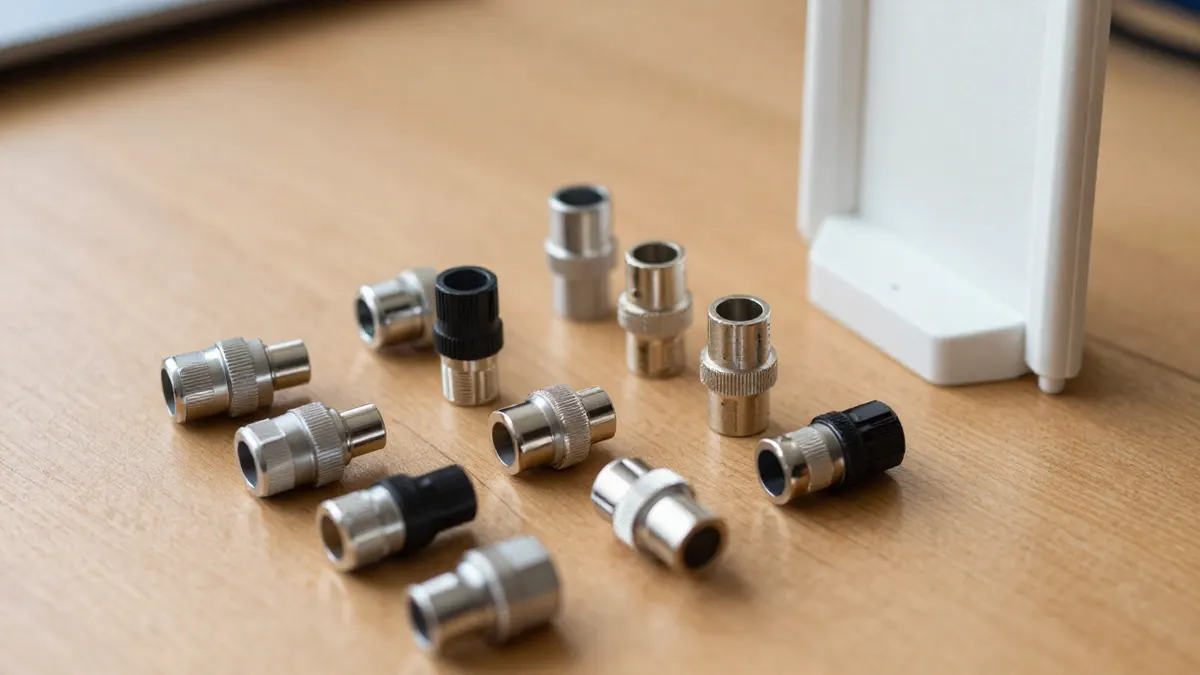
Connectors and adapters that fit LoRaWAN hotspots
Almost every outdoor antenna for the 868 MHz band (Europe) or 915 MHz band (US) ends in an N-type connector. Many miners, however, expose an SMA or RP-SMA port. That mismatch is why adapters exist.
The common pairings look like this:
- N-female to SMA-male pigtail, usually 20 to 50 cm, for connecting a miner directly to an outdoor antenna
- N-male to N-male cable, for joining an antenna to a lightning arrestor or an extension
- SMA to RP-SMA converter, only when polarity differs between miner and cable
- N-female bulkhead, for passing through an enclosure wall
Check polarity before anything else. SMA and RP-SMA look nearly identical, yet the center pin is swapped, and they will not mate properly.
How much signal does each connection cost?
Every adapter adds a loss of roughly 0.1 to 0.3 dB. Two or three of them are harmless. Ten is not.
Cable matters far more. Thin RG174 loses around 0.8 dB per metre at 868 MHz, so a 5 m run can eat 4 dB. LMR400 or similar low-loss coax drops that to about 0.1 dB per metre. For any run longer than 2 m, go with the thicker cable.
Surge protection and power accessories
An outdoor antenna is a lightning rod with a small signal attached. Fitting Helium hotspot lightning protection between the antenna cable and the miner is cheap insurance, typically a gas discharge arrestor costing about 10 to 25 EUR. It must be grounded with a short, thick wire to a real earth point, or it does very little.
Power is the other weak spot. Some outdoor miners run on Power over Ethernet, and the voltage must match. A 48V PoE injector suits many industrial-style units, while others expect 12V or 24V. Read the miner label first. Plugging a 48V injector into a device built for passive 12V will damage it.
Keep the Ethernet run under 100 m, and use shielded outdoor-rated cable if it passes along a wall in sun or rain.
Mounting hardware for better coverage
Height beats gain. A 3 dBi antenna at roof level will often outperform a 6 dBi antenna sitting behind a window. Mounting is where the extra range actually comes from.
For apartments, a Balcony mast antenna mount clamps to a railing and holds a pole of about 25 to 50 mm diameter. Aim to put the antenna above the railing line, with nothing metal within about 1 m to the sides. For houses, a chimney or wall bracket works, and stainless steel hardware lasts longer near the coast.
For a wider overview of brackets, poles and enclosures, see the notes on Helium hotspot mounting, which cover wind load and weatherproofing in more detail.
Weatherproofing the joints
Water enters at connectors, not through cable jackets. Wrap each outdoor joint with self-amalgamating tape first, then a layer of vinyl tape. Point connectors downward so water drips off. This takes ten minutes and prevents most winter failures.
What a basic outdoor kit should contain
A sensible starting set is one antenna, one low-loss cable under 3 m, one arrestor, a mast or bracket and the right power supply. Budget roughly 60 to 150 EUR for the parts, depending on cable length and antenna quality.
Skip the temptation to stack extras. Each added piece is another place for loss or water. Fewer, better parts almost always give the cleaner result.
Frequently Asked Questions
Do I need an adapter for my Helium miner?
Only if your miner port and your antenna connector differ. Many miners use SMA or RP-SMA, while outdoor antennas use N-type. Check both ends and choose a pigtail of the right gender and polarity.
How long can the antenna cable be?
Keep it as short as practical. With low-loss coax, up to 5 m is acceptable, costing around 0.5 dB. With thin RG174, stay under 1 to 2 m.
Is a lightning arrestor really necessary?
For any antenna mounted outdoors above roof height, yes. It will not stop a direct strike, but it limits induced surges that would otherwise reach the miner and your router.
Can I use any PoE injector with my hotspot?
No. Match the voltage and the standard stated on the miner. Active 802.3af/at injectors run at 48V, while passive types may deliver 12V or 24V, and mixing them can burn the board.