8 dBi Helium Outdoor Antenna (EU 868)
A helium outdoor antenna with 8 dBi gain is a fibreglass omnidirectional model, usually 80 to 120 cm long, tuned for the 863 to 870 MHz band used by LoRaWAN in Europe. It sits on a mast or a wall bracket and connects to the hotspot through an N-type connector and a coaxial cable. On a clear roof, it can reach gateways and sensors 10 to 15 km away, sometimes more over water or flat farmland.
If the 8 dBi model feels like too much gain for a small rooftop, the 5.8 dBi helium antenna is an easier fit.
Gain is not free power. An 8 dBi antenna squeezes the signal into a flatter, wider disc, so the horizontal reach goes up while the vertical coverage shrinks. That trade suits some sites and hurts others.
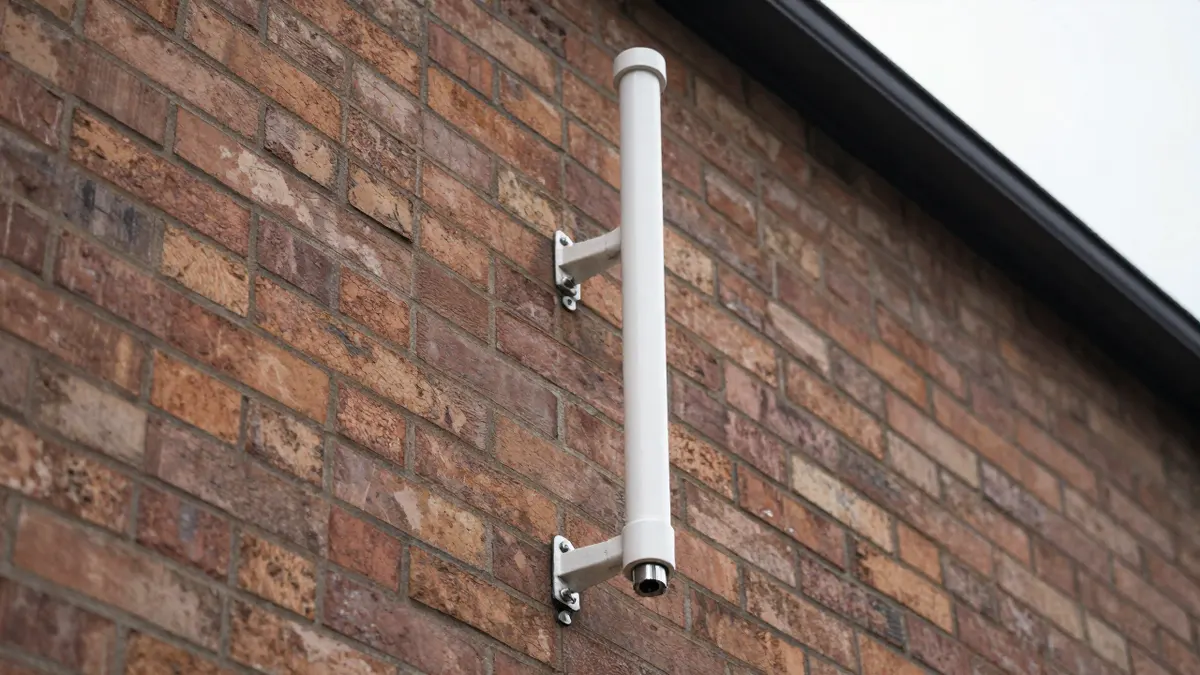
8 dBi Helium Antenna: Range, Gain and Where It Fits
The 8 dBi helium antenna has a vertical beamwidth of roughly 15 to 20 degrees. Picture a thin pancake around the mast. Devices at the same height or slightly below, across a valley or a flat plain, get a strong link. Devices directly below the antenna, such as sensors in the building that carries it, can fall outside the beam.
This is why placement matters more than the number on the box. On a 12 m mast above rooftops in a suburb, 8 dBi usually beats a smaller antenna. On a three-storey house in a hilly town, where neighbours sit well below you, a lower gain model often hears more.
If your terrain is uneven, compare it with a 5.8 dBi helium antenna, which gives a taller beam and still a decent gain. For dense city use or very short mounts, a 3 dBi helium antenna is the safer pick.
8 dBi Antenna EU868: Frequency and Connector Details
EU868 means the antenna is tuned for 863 to 870 MHz. A US915 antenna will mismatch badly here, with high reflected power and a weaker link. Check the label for the 868 MHz marking and a VSWR below 1.5.
Typical specifications for this class:
- Gain: 8 dBi, omnidirectional
- Impedance: 50 ohm
- Connector: N-female at the base
- Maximum power: about 50 W
- Wind rating: around 100 to 150 km/h
- Weight: roughly 0.5 to 1 kg
Most hotspots have an SMA or RP-SMA port, so you need a pigtail or a cable with an N-male plug at one end and the right adapter at the other.
Cable Loss and Lightning Protection
Cable eats gain. Thin RG58 loses around 0.5 dB per metre at 868 MHz, so a 10 m run swallows most of what you gained over a 3 dBi antenna. LMR400 or an equivalent low-loss cable drops that to roughly 0.1 to 0.15 dB per metre. Keep the run short. Put the hotspot as close to the antenna as you can, and feed it with Ethernet and power over a PoE cable instead of a long RF line.
Add a lightning arrestor between the antenna and the hotspot, and ground the mast with a proper earth rod. A direct strike will win regardless, but induced surges from nearby storms are the usual killer of gateways.
Mounting Tips That Change Results
Aim for at least 3 m above the nearest roofline and keep the antenna 1 m or more away from metal chimneys, gutters and other masts. Mount it vertically. A tilted omnidirectional antenna sends its beam towards the sky on one side and the ground on the other.
Use stainless clamps and seal the N connector with self-amalgamating tape plus a layer of vinyl tape. Water in the connector is the most common reason a good antenna performs badly after one winter.
For a broader comparison of gain levels, the guide on Choosing an outdoor antenna walks through site types in more detail. If you want to see other tuned models side by side, the Helium antenna shop listing is a useful starting point.
Frequently Asked Questions
Is an 8 dBi helium outdoor antenna better than a 5.8 dBi one?
Only on flat or open sites. It reaches farther horizontally, but its flatter beam misses nearby devices below it. In hilly or urban places, 5.8 dBi often performs the same or better.
Can I use an 8 dBi EU868 antenna on a US915 hotspot?
You should not. The antenna is tuned for a different band, so the match is poor and range drops. Pick an antenna that matches your hotspot's region.
How high should I mount it?
At least 3 m above surrounding roofs, and higher if trees or buildings block the horizon. Every extra few metres usually helps more than extra gain.
Do I need a special cable?
You need 50 ohm coax with an N-type connection. For runs over 3 m, choose a low-loss type such as LMR400 so the cable does not cancel the antenna's gain.