10 dBi Helium Antenna for EU868 Outdoor Hotspots
A 10 dBi Helium antenna for the EU868 band is a fiberglass omnidirectional model, usually about 60 to 80 cm long, with an N-female connector. It sits between the compact 5 dBi stubs and the long 12 dBi masts, and for many rooftop and balcony setups it is the sensible middle choice.
Gain does not create signal. It squeezes the radiation pattern flatter, so more energy travels toward the horizon and less goes up or down. That helps on flat ground and hurts in a steep valley.
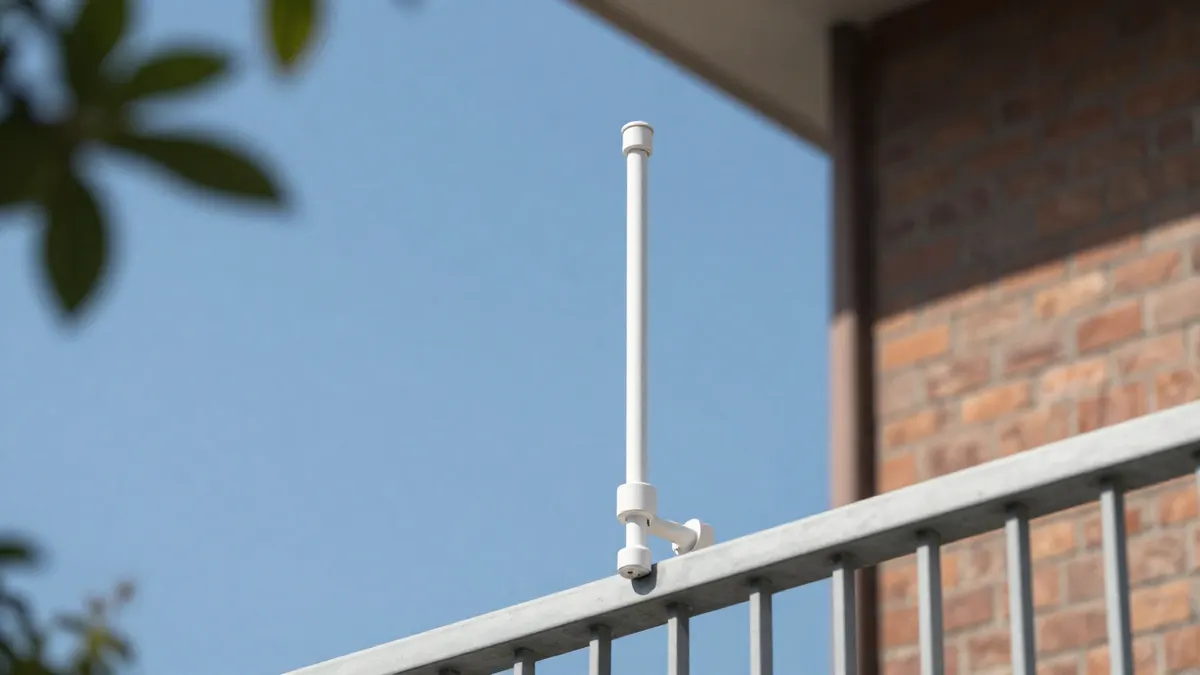
What a 10 dBi outdoor antenna for EU868 actually does
Tuned for 863 to 870 MHz, a 10 dBi collinear antenna has a vertical beamwidth of roughly 10 to 15 degrees. Picture a thin horizontal pancake around the mast. Devices at the same height or slightly below are covered well. Sensors on a hill directly above you, or in a tall block next door, may fall outside the pattern.
In open terrain with a clear line of sight, LoRaWAN links of 10 to 15 km are realistic with a good mast position. In a town, expect around 1 to 3 km, because buildings eat most of the margin. Those are practical figures, not guarantees.
Specs worth checking before you choose
- Frequency range covering 863 to 870 MHz, with VSWR below 1.5
- Impedance of 50 ohms and an N-female connector
- Power handling of at least 50 W, plenty for a hotspot at 0.025 W output
- Wind rating of about 150 km/h or more, plus a stainless mounting clamp
Skip any listing that gives a gain figure but no frequency range. Some cheap antennas are cut for 915 MHz or for 433 MHz and sell fine in the wrong region.
10 dBi Helium antenna or a different gain?
More gain is not automatically better. Pick by terrain and by where your devices are.
If your hotspot is on a low roof in a hilly area, a lower gain with a wider vertical pattern usually catches more devices. A 8 dBi outdoor antenna is a gentler step and tolerates uneven ground better. If you have a tall mast over flat farmland or a coastline, going up to a 12 dBi helium antenna stretches the horizontal reach further, at the cost of an even thinner pattern and a longer, heavier mast.
If your site has a weaker signal, an 8 dBi outdoor antenna may suit a smaller setup than the 10 dBi model.
Directional options exist too. A 9 dBi helium panel antenna covers a wedge of roughly 60 to 90 degrees, which suits a hotspot on a wall facing a town or a valley, but it leaves the back side nearly blind.
Cable, placement and installation
The coax often costs more signal than you gain from the antenna. At 868 MHz, thin RG58 loses around 0.5 to 0.7 dB per metre, so a 5 m run can swallow 3 dB. A low-loss LMR400 type cable loses closer to 0.15 dB per metre. For anything longer than 3 m, use the thick stuff, and keep the run as short as practical.
Height matters more than gain. Moving an antenna from 3 m to 10 m often does more than swapping 8 dBi for 10 dBi. Mount it vertically, plumb, at least 1 m away from metal walls, chimneys and other antennas. Keep the tip clear of anything above it.
Seal every outdoor connector. Self-amalgamating tape over the joint, then a layer of vinyl tape, keeps water out for years. Water inside an N connector is the most common reason a good antenna starts underperforming after one winter.
Lightning and grounding
A mast is the tallest object on many roofs. Fit a coax surge arrestor (often around 10 to 25 euros) near the point where the cable enters the building, and bond it to a proper earth. Local rules vary, so for a tall mast ask a qualified installer.
Is it legal and will it pass Helium rules?
In the EU868 band the radiated power limit is commonly 14 dBm ERP for much of the spectrum, with some sub-bands allowing more. A hotspot transmitting at about 14 dBm into a 10 dBi antenna with cable loss can exceed that figure. Check the settings of your miner and the rules of your country, and account for cable loss when you do the sum. Antenna gain also shows up in Helium network witness scoring, so an oversized antenna is not a free upgrade.
Frequently Asked Questions
How far can a 10 dBi Helium antenna reach?
With a clear line of sight and a mast above the surroundings, 10 to 15 km is possible. In built-up areas, 1 to 3 km is more typical. Height and cable quality change the result more than a few dB of gain.
Will a 10 dBi antenna work with any EU868 hotspot?
Most LoRaWAN gateways and hotspot miners use an N-female or SMA connector, so an adapter or pigtail is usually all you need. Confirm that the gateway is set to the EU868 plan. The antenna cannot fix a wrong region setting.
Is 10 dBi better than 5 dBi?
On flat terrain, yes, because the pattern is focused toward the horizon. In hills or when your devices are above or below the mast, a 5 dBi antenna can actually hear more of them.
Can I use it indoors?
You can, but the length of 60 to 80 cm makes it awkward, and walls remove most of the benefit. Place it near a window or in a loft if outdoor mounting is not possible.