SAW Bandpass Filter EU868 for Helium Hotspots
A SAW bandpass filter EU868 passes the 863 to 870 MHz band used by LoRaWAN in Europe and attenuates almost everything outside it. Placed between a hotspot and its antenna, it blocks nearby cellular, pager and broadcast signals that would otherwise overload the receiver. Typical insertion loss is around 1.5 to 3 dB, and rejection outside the band often reaches 30 to 40 dB.
If your hotspot sits close to a mobile tower, the filter can be the difference between a quiet radio and one that hears mostly noise.
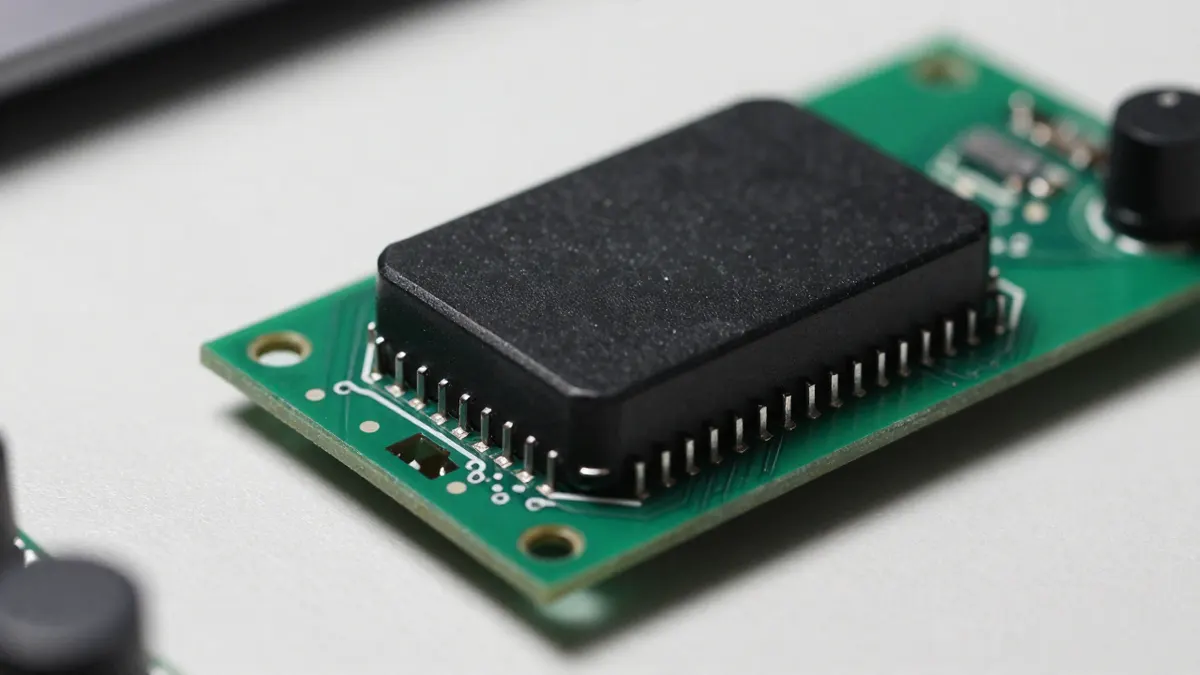
What a SAW bandpass filter EU868 actually does
SAW stands for surface acoustic wave. The filter turns the radio signal into a tiny mechanical wave on a crystal, and only frequencies matching the crystal's pattern pass through. The result is a narrow, steep passband that is hard to match with simple cavity or LC designs of the same size.
LoRa receivers are sensitive, often down to about -137 dBm at the lowest data rates. A strong LTE signal at 800 MHz, only 60 MHz below the EU868 band, can push the front end into compression long before your own gateway hears a weak sensor. The filter removes that out-of-band energy before it reaches the chip.
Helium SAW filter: when it helps and when it does not
A Helium SAW filter makes sense in a few clear cases. It does little in others, and it always costs some signal.
- Rooftop or mast installations within about 500 m of a cellular site
- Urban locations with several radios on the same roof
- Hotspots that show a high noise floor or poor receive counts despite a good antenna position
- Setups with a high-gain antenna, which also collects more interference
In a quiet rural spot, skip it. Losing 2 dB of sensitivity buys you nothing when there is no interference to remove. A better antenna position will usually do more than any filter.
Specs to check before choosing one
Frequency range and insertion loss
Look for a passband that covers 863 to 870 MHz with some margin, ideally with a stated loss under 2.5 dB. Many cheap units quote loss at the band center only. Loss at the band edges is usually higher, and that matters if you also listen on 868.1 to 868.5 MHz and 869.525 MHz.
Power handling and connectors
Most SAW filters are meant for receive paths and tolerate only a small amount of transmit power. Check the rating against your hotspot's output, which in the EU is limited to 14 dBm for most sub-bands (about 25 mW) and up to 27 dBm in the 869.4 to 869.65 MHz sub-band. Connectors are usually SMA, so confirm male and female gender on both sides before planning the chain.
Where to fit it in the antenna chain
Install it as close to the hotspot as practical, directly on the radio port or after a short jumper. Placing it at the antenna end means the long coax run carries unfiltered noise and adds its own loss before filtering happens.
Keep the order simple. Hotspot, filter, then surge protection, then the cable to the antenna. For outdoor mounts, read up on Helium hotspot lightning protection, since a filter does not protect the radio from a strike. A compact option for small indoor-to-outdoor transitions is Times Protect SMA lightning protection. If your cable run enters a building through a wall plate, an N-female to N-female bulkhead adaptor handles the pass-through.
Every extra connector adds roughly 0.1 to 0.2 dB of loss. Four connectors and a filter can easily cost 3 dB in total, so count them.
Testing whether it worked
Compare before and after over at least 48 hours. Note the number of witnessed beacons or received packets, and if your gateway software shows RSSI or noise statistics, record the average. A good result is a lower noise floor with little change in the signal level from known sensors.
If packet counts drop, remove it. That usually means you had little interference in the first place.
Frequently Asked Questions
Can I use a US915 filter on EU868?
No. A US915 filter passes roughly 902 to 928 MHz, so it would block your EU868 signals almost completely. Always match the filter to the band your hotspot uses.
Will a SAW filter increase my range?
No, it reduces signal slightly. Range improves only when interference was the limiting factor, because the receiver then hears weak packets it previously missed.
Does the filter go on the transmit side too?
In a hotspot, the filter sits in the shared antenna path, so it affects both receive and transmit. Choose a unit rated for your transmit power, otherwise the filter may overheat or degrade over time.
How much does a SAW bandpass filter cost?
Prices vary, but basic EU868 modules usually start at around 10 to 15 EUR, while enclosed units with SMA or N connectors can reach 40 EUR or more.