45cm Low Loss Flat Coaxial Cable SMA RP for Window Pass-Through
A flat coaxial cable SMA RP is a thin, ribbon-shaped RF cable with an SMA reverse polarity connector at each end. Its job is simple: carry the signal from a hotspot sitting indoors to an antenna mounted on the outside of a window, without drilling a hole and without leaving the window open. At 45cm, this version suits a hotspot placed right next to the glass.
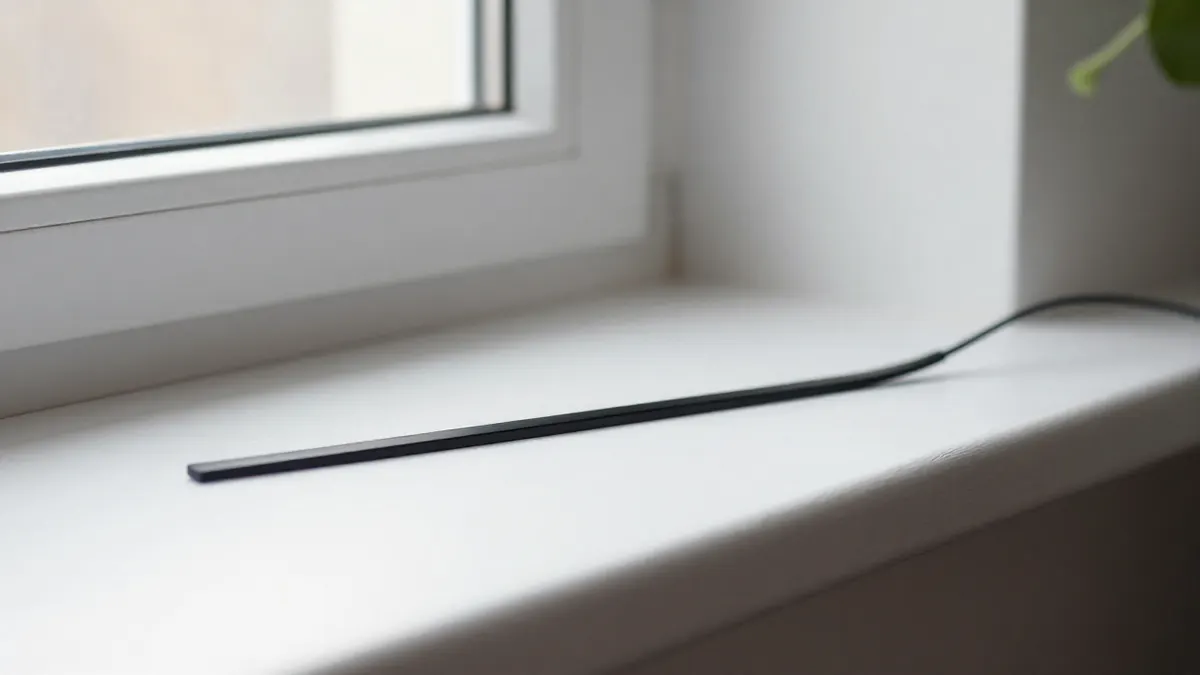
How a flat coaxial cable SMA RP passes through a window
The cable is only about 0.3 to 0.5mm thick along its flat section. That is thin enough to run between the window sash and the frame, and the rubber seal closes over it again. Draughts stay out, and the window shuts normally.
A round cable such as RG58 cannot do this. It is around 5mm across, so it either crushes the seal or leaves a gap you can feel in winter.
The connectors stay standard. You get an SMA plug on one side and a jack on the other, using the reverse polarity pin layout common on LoRaWAN gear. Check your hotspot and your antenna before anything else, because an SMA RP end will not mate properly with a standard SMA end.
Is 45cm the right length?
Short cables lose less signal. That is the main reason to choose the smallest length that actually reaches. A 45cm run leaves enough slack to go from a hotspot on a windowsill or a nearby shelf, across the frame, to an antenna stuck to the outside pane or hanging on a bracket.
If the hotspot sits on a desk two metres from the window, 45cm will not get there. Do not stretch the cable tight around the connector, since that damages the centre pin over time.
Other lengths exist for different layouts. For a very tight setup, a 15cm low loss coaxial cable is enough. A 40cm low loss coaxial cable is a close cousin of this one, and a 100cm window pass-through cable fits when the hotspot is further back in the room.
Signal loss you can expect
Flat cables lose more per metre than thick low loss cable, but over 45cm the difference is small. At 868MHz (the EU LoRaWAN band), expect roughly 0.3 to 0.6dB of loss for a cable this short. At 915MHz the figure is similar.
That is less than the loss from one badly crimped adapter. So the cable itself is rarely the weak point. Poor antenna placement, a metal-coated window or an extra adapter in the chain will cost you far more.
- Coated or low-e glass can block a lot of signal, so mount the antenna outside it.
- Every added adapter costs around 0.2 to 0.5dB.
- Keep the flat section away from sharp frame edges.
Installing it without damaging the cable
Open the window, lay the flat section across the frame where the seal meets the sash, and close it slowly. Do not force it. If the window will not latch, shift the cable to a flatter spot or to a corner where the seal is softer.
Leave a small loop of slack on both sides. Wind and temperature change move the antenna a little, and a taut cable will pull on the connector. Screw the SMA nuts finger tight, then add a quarter turn at most. Over-tightening is the usual reason for a cracked connector.
Outdoors, a drop of self-amalgamating tape around the connector keeps moisture out. Rain getting into an SMA joint is a common reason for a hotspot that worked in summer and fades by November.
Choosing between window cables
If you are comparing options, the Helium antenna window cable overview covers the main variants side by side. As a rule, pick the shortest cable that reaches without tension, check the connector type on both ends, and prefer a cable with a gold-plated centre pin if the installation is permanent.
Flat cables are fine for fixed installs, but they dislike repeated bending. If you plan to move the hotspot often, a round cable with a pigtail is the more durable choice.
Frequently Asked Questions
Will a flat coaxial cable damage my window seal?
Usually not. The flat section is thin enough that most rubber seals close around it. Over years, a seal can take a slight permanent set at that spot, so move the cable now and then if you can.
Can I use this cable with a standard SMA antenna?
Only if the connector types match. An SMA RP end has the opposite centre contact from a standard SMA end, so a mismatch will not connect or will give no signal. Read the markings on the hotspot port and antenna base before choosing.
How much signal does a 45cm flat cable lose?
Around 0.3 to 0.6dB at 868MHz, depending on the build quality. That is a small fraction of what a poor antenna position can cost you.
Is it waterproof?
The cable jacket resists light moisture, but the connectors are not sealed. If one end sits outside, wrap the joint with weatherproof tape and point it downward so water runs off.